We did it 🏆 Last weekend was the first ever Global WordPress Translation Day and it happened just as planned and exceeded our expectation about the overall activity. It was a great first event of what I’m hoping we can turn into a regular series so we can get together more often, bring new people on board and improve our processes, documentation and, let’s face it… our contributing experience overall.
What we did
- 24 hours of live streaming sessions inspired by WordSesh but focused on translation training and developer training on i18nInternationalization Internationalization (sometimes shortened to I18N , meaning “I – eighteen letters -N”) is the process of planning and implementing products and services so that they can easily be adapted to specific local languages and cultures, a process called localization. This is the process of making software translatable. Information about Internationalization for developers can be found in the Developer’s handbooks. & L10nLocalization Localization (sometimes shortened to “l10n“) is the process of adapting a product or service to a particular language, culture, and desired local “look-and-feel.”
- Local contributor days in as many cities in the world as we could get to commit solely focused on translating WordPress
How we organised it
Everything was organised in an open Google Spreadsheet that everyone had access to edit. The ultimate exercise in trust and initiative as everyone could jump on and add information/change/ask questions.
The Website
We are all extremely grateful to Scott Basgaard who allowed us to basically clone the last WordSesh site and change the content, so http://wptranslationday.org is basically WordSesh with our colours and content. The Website allowed us to have a real marketing campaign and in less than 3 weeks we got more than 1300 people to sign up to take part of the event.
24 hours of live streaming sessions
For the live streaming sessions, we used CrowdCast, which worked beautifully and I would highly recommend if we ever decide to do webinars or any online training.
All the videos from the sessions are here: https://www.crowdcast.io/e/wptranslationday/ and will stay available to watch (can also be downloaded). The developer sessions and the translation training will all go on WordPress.TV as well and will be used in various documentation parts of make.wordpress.orgWordPress.org The community site where WordPress code is created and shared by the users. This is where you can download the source code for WordPress core, plugins and themes as well as the central location for community conversations and organization. https://wordpress.org/
- 317 people watched the live streaming sessions
- We had live video translation training for 12 languages – Japanese (in that language, by the GTEGeneral Translation Editor A General Translation Editor (often referred to as GTE) is a person, who has global access to validate strings on all projects for a specific locale. team) and a general one for all localesLocale Locale = language version, often a combination of a language code and a region code, for instance es_MX denotes Spanish as it’s used in Mexico. A list of all locales supported by WordPress in https://make.wordpress.org/polyglots/teams/ in English that I did in the beginning of the day.
- How to translate WordPress – general introduction in English with Petya Raykovska
- Translate WordPress to Japanese with Naoko Takano
- Translate WordPress to Hindi with Saurabh Shukla and Gagan Deep Singh
- Translate WordPress to Bulgarian with Petya Raykovska
- Translate WordPress to German with Birgit Olzem
- Translate WordPress to Slovak with Peter Nemcok
- Translate WordPress to Italian with Paolo Valenti (Wolly)
- Translate WordPress to Dutch with Taco Verdo
- Translate WordPress to Spanish with Luis Rull
- Translate WordPress to French with FX Benard
- Translate WordPress to Swedish with Isaac Keyet
- Translate WordPress to Lithuanian with Justina Baskyte
- Translate WordPress to Portuguese with Claudio Sanches
- There were 22 live sessions overall including development training and translation training, several videos from different WordCamps dedicated to i18n & L10n.
I’m learning a lot about WordPress translations from @petyeah as a part of #WPTranslationDay. Y’all should watch: https://t.co/V1yjOFBcLm
— Aaron Jorbin (@aaronjorbin) April 24, 2016
Speak only one language? Peak at #WPTranslationDay hashtag or live stream anyway and appreciate how many outside the US use WordPress.
— David Bisset (@dimensionmedia) April 24, 2016
We had several sessions aimed at pluginPlugin A plugin is a piece of software containing a group of functions that can be added to a WordPress website. They can extend functionality or add new features to your WordPress websites. WordPress plugins are written in the PHP programming language and integrate seamlessly with WordPress. These can be free in the WordPress.org Plugin Directory https://wordpress.org/plugins/ or can be cost-based plugin from a third-party. and theme developers whether it was to advise them on how to find translators for their themes and plugins or to teach them how to prepare them for L10n
- Plugin and theme authors: How to find translators for your plugins and themes with Petya Raykovska
- Internationalisation for WordPress developers – the right way to prepare your themes and plugins for translation with John Blackbourn
- The life of a string – or how WordPress gets its translations – with John Blackbourn and Nikolay Bachiyski
- How to prepare your theme and plugin for Translate.wordpress.org with Claudio Sanches
I also want to thank Danielle who jumped on the schedule last minute to wake us up and chat about his great browser extension GlotDict that helps translators get a global Glossary. You can watch the session here. here.
Local events – stand alone contributor days dedicated to translating WordPress

- 39 local events on 4 continents 🌍🌎🌏
- 11 remote events in different locations 💻
- 448 people submitting translations 👏
- 153 people got a polyglots badge, which means they submitted their first stringsString A string is a translatable part of the software. A translation consists of a multitude of localized strings. ever during that day! 🎈⭐️❤️
Results 🤘🏻
Staring at the top of the pile of strings we translated during the Dutch #wptranslationday meetupMeetup All local/regional gatherings that are officially a part of the WordPress world but are not WordCamps are organized through https://www.meetup.com/. A meetup is typically a chance for local WordPress users to get together and share new ideas and seek help from one another. Searching for ‘WordPress’ on meetup.com will help you find options in your area.! #community pic.twitter.com/hnC3OJsHTS
— Taco Verdo (@TacoVerdo) April 25, 2016
As of Monday morning, these are the final stats for the day that Dominik pulled from translate.w.org:
How much got translated 📈
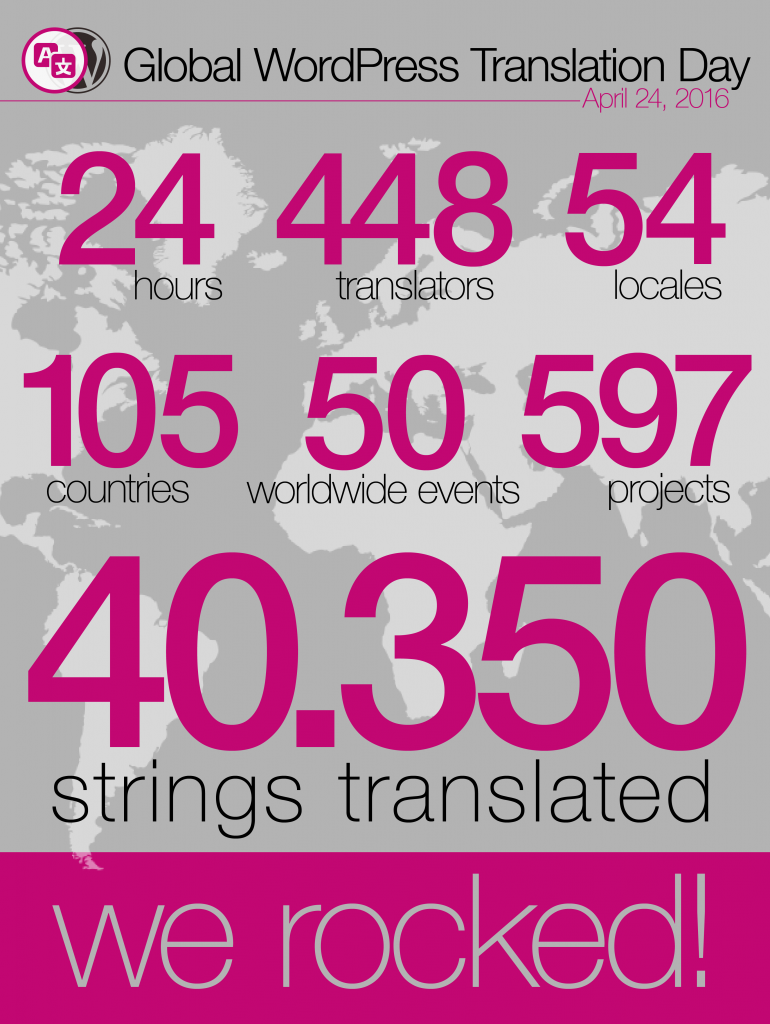
A infographic by Raffaella Isidori
- 40350 strings translated during the 24 hours
- 597 projects on translate.wordpress.orgtranslate.wordpress.org The platform for contributing to the translation of WordPress core, themes and plugins. had new strings submitted
- 53 locales got updated with new translations (just for WordPress, not including plugins and themes)
- 17 new translation editorsTranslation Editor Translation editors can approve translations for projects. The GTE (General Translation Editor) and LM (Locale Manager) roles can add new users with the “Project Translation Editor” role that can approve translations for specific projects. There are two different Translation Editor roles:
General Translation Editor and Project Translation Editor were added across different locales - 15 locales got more than 1000 new strings translated
Who translated the most 🏆
55 locales got contributed to during the 24 hours of the sprint, with 15 locales getting more than 1000 strings in. A stunning 597 projects got new strings translated across all projects (WordPress, Plugins and themes). Here’s the data by localeLocale Locale = language version, often a combination of a language code and a region code, for instance es_MX denotes Spanish as it’s used in Mexico. A list of all locales supported by WordPress in https://make.wordpress.org/polyglots/teams/:
| English (Canada) | en-ca | default | 4123 |
| Thai | th | default | 3494 |
| Japanese | ja | default | 2922 |
| Turkish | tr | default | 2899 |
| German | de | default | 2896 |
| Bulgarian | bg | default | 2655 |
| French | fr | default | 2315 |
| Dutch | nl | default | 2298 |
| Spanish | es | default | 2219 |
| Italian | it | default | 1961 |
| German (Formal) | de | formal | 1856 |
| Slovak | sk | default | 1738 |
| Marathi | mr | default | 1171 |
| Malayalam | ml | default | 901 |
| Greek | el | default | 782 |
| Croatian | hr | default | 671 |
| Russian | ru | default | 589 |
| Tajik | tg | default | 579 |
| Dutch (Formal) | nl | formal | 527 |
| Venezuelan Spanish | es-ve | default | 451 |
| Afrikaans | af | default | 342 |
| Gujarati | gu | default | 336 |
| Polish | pl | default | 304 |
| Finnish | fi | default | 286 |
| Swedish | sv | default | 255 |
| Chilean Spanish | es-cl | default | 248 |
| Brazilian Portuguese | pt-br | default | 192 |
| Spanish (Mexico) | es-mx | default | 188 |
| Romanian | ro | default | 180 |
| Hindi | hi | default | 148 |
| Norwegian (Bokmål) | nb | default | 130 |
| Hebrew | he | default | 112 |
| Chinese (China) | zh-cn | default | 97 |
| Bengali | bn | default | 80 |
| Serbian | sr | default | 75 |
| Persian | fa | default | 50 |
| Lithuanian | lt | default | 47 |
| Hungarian | hu | default | 34 |
| Kannada | kn | default | 33 |
| Albanian | sq | default | 30 |
| Tibetan | bo | default | 26 |
| Portuguese (Portugal) | pt | default | 20 |
| Chinese (Taiwan) | zh-tw | default | 18 |
| Tamil | ta | default | 15 |
| Javanese | jv | default | 12 |
| Asturian | ast | default | 8 |
| Turkmen | tuk | default | 8 |
| English (UK) | en-gb | default | 7 |
| Ukrainian | uk | default | 7 |
| Emoji | art-xemoji | default | 5 |
| English (Australia) | en-au | default | 5 |
| Azerbaijani (Turkey) | az-tr | default | 2 |
| Vietnamese | vi | default | 2 |
| Czech | cs | default | 1 |
What else did we improve during the day
- We got a global list of glossaries and style guides going and it has a lot of resources already
- We improved our getting started documentation based on feedback we got
- Many teams got new project translation editors and potential General Translation Editors
- People from different regions in the same country started talking
- We raised awareness about our work across the globe
The Buzz
During the day, the hashtag got updates from 202 accounts, 500 posts were sent that generated 945,251 impressions. See all the pictures and all the buss on the official hashtag #WPTranslationDay. Here’s just a small selection of photos.
How is your #WPTranslationday going?
— Luca Sartoni (@lucasartoni) April 24, 2016
Thank you!
I like to thank several people who made this event possible.
Scott Baasgard, for providing the WordSesh site infrastructure and all the WordSesh know-how for our live streaming sessions. Thank you, Scott, this couldn’t have happened without you. A big thank you to SiteGround, who donated the hosting and domain and provided solid support during the event.
Chantal and Nao, who helped me so much with the site and the communication across teams providing tech support, copy for the internal blog posts and constantly had my back when I needed it.
To each and every one of you who submitted a video for our great promo video and helped spread the word about the event after.
To Yana, who edited the video in one night, Hacko and Rob, who fixed bugs and helped me make sense of the different screencast options.
To all of you wonderful GTEs who committed your time to creating a presentation for the day, we’re paving the way to better documentation and more openness in the team, thank you. To all our other wonderful speakers, John, Nikolay, Claudio, Danielle, who did the technical sessions for theme and plugin developers.
To everyone who jumped into the idea and organised a local or a remote event during the day – you were the backbone of this initiative and we couldn’t have done this without you. You are a true inspiration and I’m sure we’ll get even more events next time thanks to your work.
And to Sonja, who stayed up with me for 25 hours providing support, tea, laughs, taking over when needed and who also spend the whole 25 hours translating to German in between taking care of me.
I love how this event brought us all together and I hope you all agree that we should do it again and soon.
How did the day go for you?
Share your impressions. Would you like to do it again? What should we do differently next time? Let’s make it even better.
Love,
Petya